
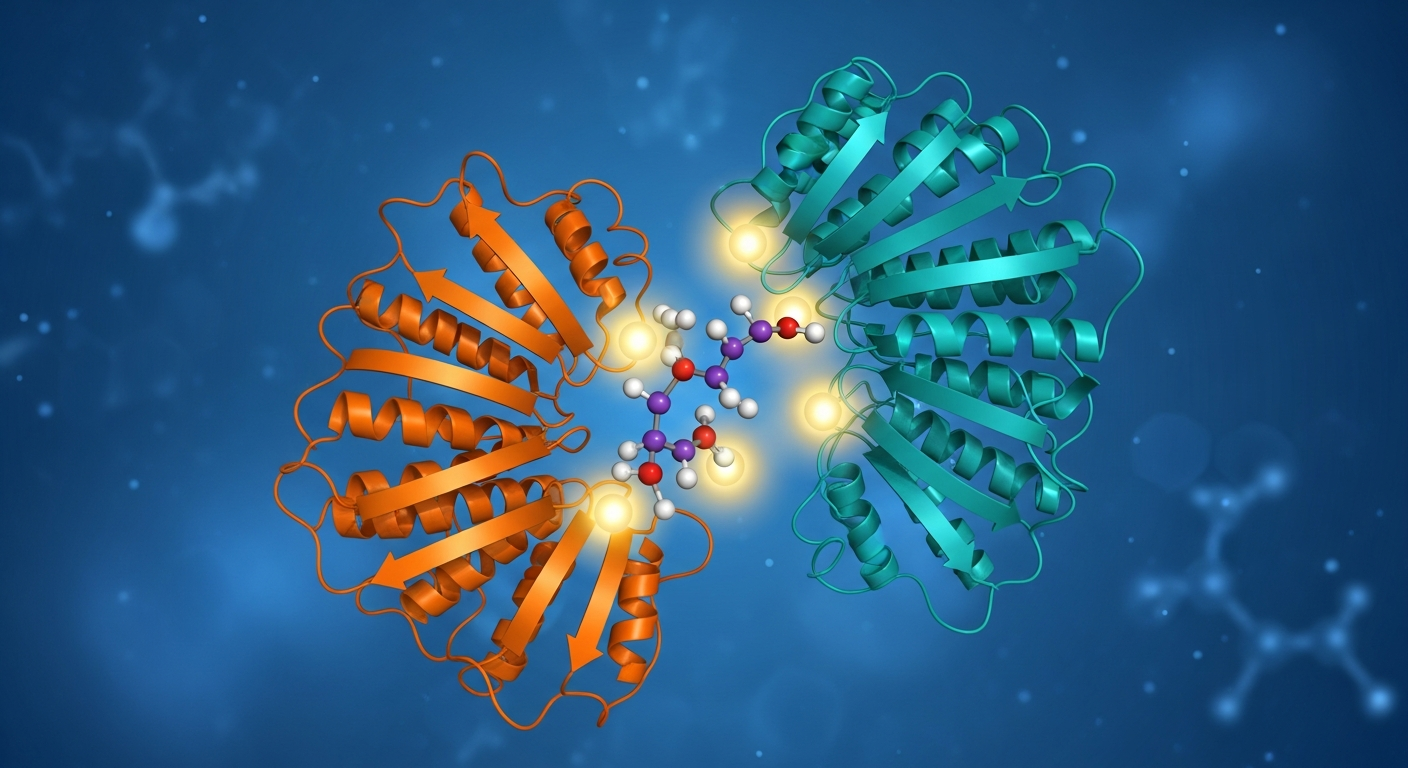
Google DeepMind has published results from AlphaFold 3, the latest version of its protein structure prediction system, showing that the model can now predict how drug molecules interact with protein targets at near-experimental accuracy levels. The findings, published in Science, represent a significant advance from the original AlphaFold system that predicted static protein structures.
Beyond Static Structures
While AlphaFold 2 revolutionized structural biology by predicting single-protein structures with remarkable accuracy, it could not model the dynamic interactions between proteins and other molecules — precisely the kind of information needed for drug design.
AlphaFold 3 uses a diffusion-based architecture that can predict the 3D structure of molecular complexes including proteins, DNA, RNA, and small-molecule drugs. In benchmark tests, the system predicted binding poses for drug-like molecules with a median RMSD of 1.4 angstroms — close to the resolution of experimental methods like X-ray crystallography.
Impact on Drug Discovery
“This changes the economics of early-stage drug discovery,” said Dr. Patrick Walters, VP of Computation at Relay Therapeutics. “Structure-based drug design has always been bottlenecked by the need for experimental structures of drug-target complexes. If AlphaFold 3 predictions are reliable enough, you can screen millions of compounds computationally before touching a single test tube.”
Several pharmaceutical companies have already begun integrating AlphaFold 3 predictions into their discovery pipelines. Isomorphic Labs, DeepMind’s drug discovery spinoff, has active partnerships with Eli Lilly and Novartis that are leveraging the technology.
Limitations and Caveats
Researchers caution that AlphaFold 3 predictions are not a complete replacement for experimental validation. The system struggles with certain classes of targets, including highly flexible proteins and membrane-bound receptors. Additionally, prediction accuracy drops for novel chemical scaffolds that are dissimilar to compounds in the training data.
Perhaps most significantly, AlphaFold 3 predicts binding poses but not binding affinity — it can show where a drug binds, but not how tightly. Binding affinity prediction remains one of the hardest unsolved problems in computational chemistry.